Introduction
Businesses today rely heavily on technology to run their operations, serve customers, analyze data, and stay competitive. Off-the-shelf software can help solve common business problems, but it may not always be a good fit for the unique requirements of each organization. This is the point where custom software development becomes important.
Custom software is developed and created to fit the specific needs, processes, goals, and problems of a particular business. Instead of shaping your business processes to fit an off-the-shelf application, custom software enables technology to be built around the way your business truly works.
From customer relationship management and inventory management to enterprise applications, workflow automation, mobile applications, and business intelligence platforms, custom software solutions can help organizations across multiple sectors.
Choosing the right custom software development company is an important decision for businesses looking to embark on a digital transformation. A good solution can increase productivity, automate repetitive tasks, simplify operations, improve customer experiences and lay the foundation for future growth.
In this guide, we will explore what custom software development means, its benefits, development process, costs, challenges, and how businesses can choose the right development partner.
What Is Custom Software Development?
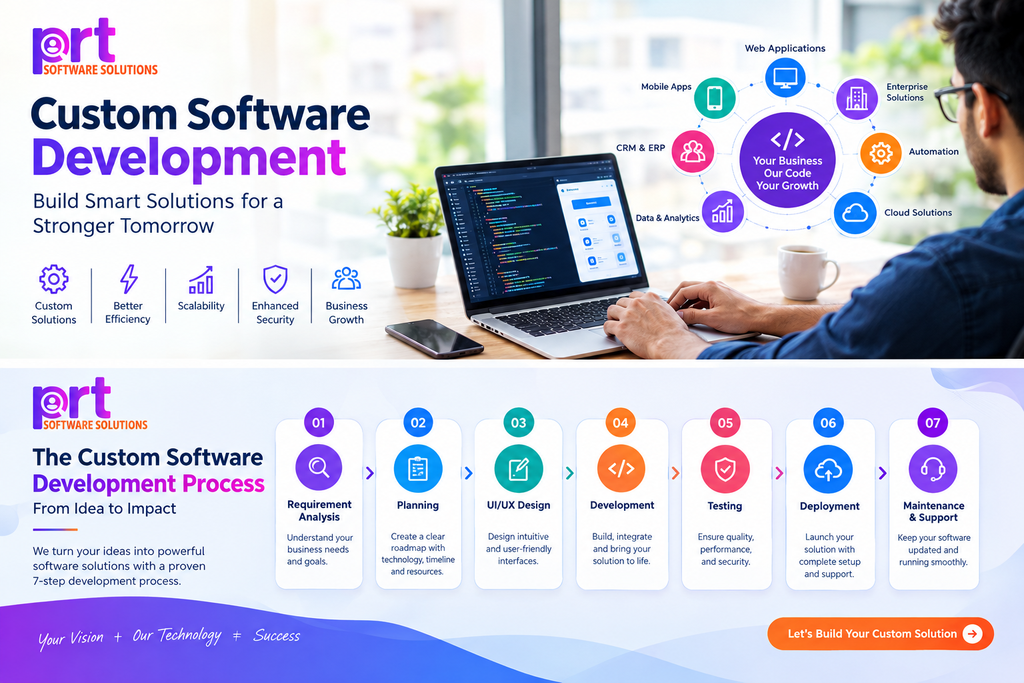
Custom software development is the process of designing, building, testing, deploying and maintaining software that is tailored for the needs of an individual business or organization.
Commercial off-the-shelf software is built for the general market, while custom software is built around specific business processes and goals.
For example, a company may need software to:
- Manage customers and leads
- Track inventory
- Automate internal workflows
- Manage employees and projects
- Process orders
- Generate business reports
- Integrate multiple business systems
- Manage financial operations
- Provide customer portals
- Automate repetitive tasks
- Analyze business data
A business does not have to depend on a number of disparate applications; a tailored platform can consolidate key processes.
A professional custom software development company generally collaborates with the business to understand its requirements and then designs the solution, develops the application, tests it, deploys it and provides ongoing support.
Why Do Businesses Need Custom Software?
The way each business works is different. Even in the same industry, different companies can have different workflows, customers, internal processes and technology needs.
Off-the-shelf software usually comes with standard features that are designed for a large number of users. This may be convenient, but there are limitations for businesses such as:
- Features they do not need
- Missing features they require
- Limited integrations
- Restricted customization
- Scalability limitations
- Complex workarounds
- Data management challenges
- Limited control over workflows
Custom software development solves these problems by building a solution around the real needs of the organization.
“Custom software is not just another business application, it could be a strategic technology investment for growing businesses.
Custom Software vs. Off-the-Shelf Software
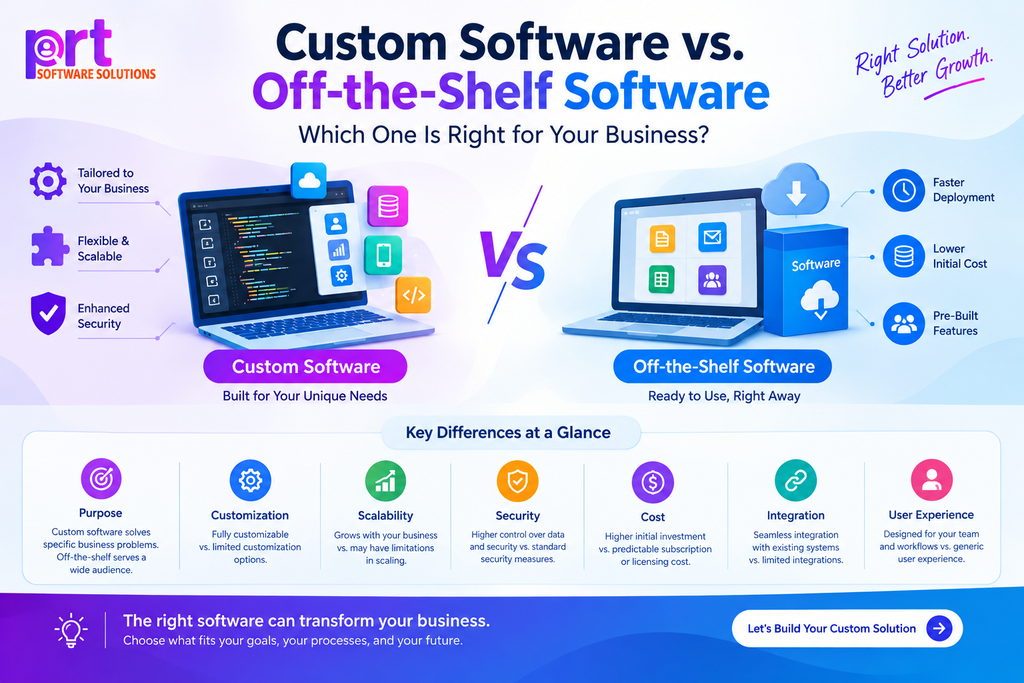
One of the biggest decisions businesses face is whether to buy an existing application or build a custom solution.
Off-the-Shelf Software
Key Benefits of Custom Software Development
Designed Around Your Business
One of the great things about custom software is that it can be designed around the real processes of your organization.
Rather than making your staff adapt their workflow to a one-size-fits-all software, the application can be designed around how your business operates.
This can ease daily processes and cut down on unnecessary steps.
Improved Business Efficiency
Manual processes can take up employee time.
For example, employees may spend hours:
- Entering data
- Creating reports
- Updating spreadsheets
- Sending repetitive emails
- Managing records
- Moving information between systems
Many routine activities can be replaced with custom software.
Automation can free employees to spend more time on tasks that require human decision-making, communication and creativity.
Better Scalability
The needs of a business change as it grows.
At first, a small business may only need a simple application, but as a growing organization matures, it may eventually need:
- More users
- More data storage
- Additional integrations
- Advanced reporting
- Mobile access
- Automated workflows
- New business modules
A properly planned custom software solution can be designed with future expansion in mind.
Integration With Existing Systems
Most companies have lots of different software applications that do different things.
For example, an organization might have separate systems for:
- Accounting
- Customer management
- Inventory
- Human resources
- Sales
- Marketing
- Communication
If these systems are not well connected, employees may need to manually transfer information between platforms.
Custom application development can involve integrations that enable different systems to share relevant information.
This can cut down on duplicate data entry and improve operational visibility.
Enhanced Data Security
Security has to be part of the development of business software.
Custom software provides organizations greater control over how their applications handle data processing, authentication, user permissions and access.
Security requirements can be integrated into the architecture and development process.
Depending on the application, businesses might implement features such as:
- Role-based access
- User authentication
- Permission management
- Data encryption
- Audit logs
- Secure APIs
- Backup strategies
The security requirements should be evaluated based on the purpose of the application, the sensitivity of data, industry requirements, and applicable regulations.
Better User Experience
Software should make work easier, not more difficult.
Custom software can be customized to the needs of its users.
For example, employee dashboard can show the information an employee needs most frequently, instead of dozens of features they don’t need.
User-centric design can improve usability and adoption.
Greater Control Over Features
Custom software development gives businesses more control over the application’s functionality.
Businesses don’t need to wait for a software vendor to install a feature but can work with their development partner to plan enhancements according to their needs.
This can be especially helpful for organizations with specialized workflows.
Competitive Advantage
Technology can impact how efficiently a business runs.
A company with simplified workflows, automated processes, better data visibility and integrated systems may be able to respond to customers and market changes more effectively.
This is why custom software can be part of a company’s wider digital transformation strategy
Types of Custom Software Solutions
Custom software development can cover many different types of applications.
Customer Relationship Management Software
Custom CRM applications can help businesses manage:
- Leads
- Customers
- Sales activities
- Follow-ups
- Customer communication
- Sales pipelines
- Reports
Enterprise Software
Enterprise applications are used by big organizations to connect different departments and business functions.
Inventory Management Software
Custom inventory systems can help businesses track:
- Products
- Stock levels
- Purchases
- Sales
- Warehouses
- Suppliers
- Inventory movement
Workflow Automation Software
Businesses can automate repetitive workflows like approvals, notifications, data processing and task assignments.
Business Management Software
A custom business management platform can combine several functions into one system.
Mobile Applications
Companies can create custom Android, iOS or cross-platform mobile apps for employees, customers, partners or other users.
Customer Portals
Custom portals can offer customers services, orders, documents, support requests, account information and other features.
The Custom Software Development Process
A successful project requires a structured development process.
Requirement Analysis
The first step is to understand the business problem.
A development team should identify:
- Business objectives
- Target users
- Current workflows
- Pain points
- Required features
- Integration requirements
- Security requirements
- Expected future growth
Clear requirements provide a foundation for the project.
Planning
Once the requirements are understood, the development team will create a project plan.
This may include:
- Project scope
- Technology selection
- Development methodology
- Project milestones
- Resource planning
- Estimated timeline
- Testing strategy
- Deployment plan
Good planning can help reduce the chances of unexpected problems later in the development.
UI/UX Design
User interface and user experience are designed as per the requirements.
Designers consider:
- Navigation
- Layout
- Accessibility
- User workflows
- Mobile responsiveness
- Information hierarchy
- Usability
A well-designed interface can make the final application easier to use.
Software Development
The developers start building the application according to the approved requirements and designs.
Depending on the project, development may include:
- Front-end development
- Back-end development
- Database development
- API development
- Third-party integrations
- Authentication
- Cloud infrastructure
Development is generally performed in stages so that functionality can be reviewed and tested throughout the project.
Testing
Testing is an important phase of the software development process.
Different types of testing that development teams may do:
- Functional testing
- Integration testing
- Performance testing
- Security testing
- Usability testing
- Compatibility testing
- User acceptance testing
The objective is to identify and resolve problems before the software reaches production.
Deployment
Once the application has been successfully tested and approved, it can be deployed.
Deployment may involve:
- Server configuration
- Cloud infrastructure
- Database migration
- Domain configuration
- Security settings
- User account setup
- Production monitoring
The deployment strategy depends on the type and complexity of the software
Maintenance and Support
Software development does not necessarily end after deployment.
Businesses may require ongoing:
- Bug fixes
- Security updates
- Performance improvements
- Feature enhancements
- Technical support
- Infrastructure management
Continuous improvement can help the application remain useful as business requirements evolve.
How Much Does Custom Software Development Cost?
The cost of custom software can vary widely from project to project.
There isn’t one size that fits all as each software development project is different.
The factors that influence development costs are:
Project Complexity
Single internal application will normally require less resources than large enterprise platform.
Number of Features
More functionality typically requires more development, testing, and design work.
Platforms
Building a web application may require different requirements than building separate native mobile applications for Android and iOS.
Integrations
Integration with third-party services, APIs, payment systems, CRM systems, ERP systems or any other applications can increase the complexity of the project.
UI/UX Requirements
Interfaces and user experiences that are highly customized may require additional design and development effort.
Security Requirements
Applications that handle sensitive business or customer information may require additional security controls and testing.
Maintenance
When planning the overall technology budget, consider ongoing support and future feature development as well.
To get an accurate estimation, businesses need to share their requirements with a custom software development company for a project-specific evaluation.
How to Choose a Custom Software Development Company
Choosing the right development partner can make a big difference to project outcomes.
Think about these factors.
Technical Expertise
Check whether the development company has experience in the technologies you need for your project.
Relevant Experience
Look for experience with applications similar to your own business needs.
Portfolio
Review previous projects to learn about the company capabilities, design quality and technical experiences.
Development Process
Ask how the company handles:
- Requirements
- Design
- Development
- Testing
- Communication
- Deployment
- Support
Communication
Good communication is a must during the complete software development project.
You need to understand the frequency of project updates and the process for handling questions and changes and such.
Security Practices
Ask about application security, data protection, authentication, access control, testing and backup procedures.
Post-Launch Support
Find out what support is available after the software goes live.
Scalability
Discuss how the application can be expanded if your business grows.
Common Mistakes to Avoid
Businesses can reduce project risks by avoiding common software development mistakes.
Poor Requirement Definition
Unclear requirements can lead to misunderstandings and unexpected changes.
Focusing Only on Price
The lowest initial quote is not necessarily the lowest total cost of ownership over the life of a software project.
Companies should take into account the value, quality, scalability, support, and long-term needs.
Ignoring User Experience
Software that technically works but is difficult to use may have poor adoption.
Skipping Testing
Insufficient testing can result in reliability, performance, and security problems.
No Long-Term Strategy
Businesses should consider how the application may evolve after launch.
Custom Software Development for Small and Medium Businesses
Custom software isn’t only for big enterprises.
Customized applications may also help small and medium businesses to improve certain processes.
For example, a growing business could benefit from software that integrates:
- Customer management
- Sales tracking
- Inventory
- Invoicing
- Reporting
- Employee management
Instead of buying a set of unrelated tools, the business can assess the financial and operational viability of a made-to-order platform.
The trick is to find the processes where the software can really add measurable value.
How Custom Software Supports Digital Transformation
Digital transformation is not simply about buying new software.
It generally means better leveraging technology, data and automation to run the business and serve customers.
“Custom software can help with digital transformation by tying up business processes and creating centralized systems.
For example:
Manual process → Digital workflow → Automation → Data collection → Reporting → Business insights
This approach can help organizations gradually improve operational efficiency.
Future Trends in Custom Software Development
Technology changes . Businesses have to factor in new capabilities when planning new software .
Artificial Intelligence
AI can support applications through features such as:
- Intelligent search
- Document processing
- Recommendations
- Chatbots
- Data analysis
- Workflow assistance
Cloud-Based Applications
Cloud infrastructure provides the flexibility for applications that need remote access, scalability, and centralized management.
API-Based Integrations
Today, more and more applications rely on APIs to connect different systems and services.
Mobile-First Experiences
As employees and customers increasingly use mobile devices, mobile-friendly software experiences remain important.
Automation
Business process automation can reduce repetitive manual work and improve workflow consistency.
Why Businesses Should Plan Software for the Long Term
A software application should not be viewed only as a short-term project.
Businesses should consider:
- Future users
- Future features
- Data growth
- Integration requirements
- Security updates
- Performance
- Maintenance
- Technology changes
A scalable architecture can allow for future improvements.
That is why the choice of a qualified software development company and the determination of exact technical specifications are significant steps before starting the development.
Frequently Asked Questions About Custom Software Development
What is custom software development?
Custom software development is the process of creating software specifically for the requirements of a particular business or organization.
Is custom software better than off-the-shelf software?
Neither option is universally better. The appropriate choice depends on business requirements, budget, complexity, scalability, integrations, and available products.
How long does custom software development take?
The timeline depends on the project’s scope, complexity, number of features, integrations, testing requirements, and development resources.
How much does custom software development cost?
Costs vary based on project requirements. A simple application may require significantly less investment than a complex enterprise platform with multiple integrations and advanced functionality.
Can custom software integrate with existing systems?
Yes. Custom applications can be designed to integrate with existing systems through APIs, databases, middleware, or other integration approaches, depending on technical compatibility.
Is custom software scalable?
Custom software can be designed with scalability in mind. Architecture, infrastructure, database design, and application requirements should be considered during the planning stage.
Does custom software require maintenance?
Yes. Software may require security updates, bug fixes, performance improvements, infrastructure management, and new features over time.
How do I choose a custom software development company?
Consider technical expertise, relevant experience, portfolio, development process, communication, security practices, scalability, pricing, and post-launch support.
Conclusion
Custom software development helps businesses create technology solutions that closely fit their specific processes and goals.
Custom software provides a host of benefits to organizations that have outgrown off-the-shelf solutions, including automating mundane jobs, integrating business systems, improving customer experiences, and powering future growth.
But good software development is more than just coding. Successful projects have clear requirements, thoughtful design, appropriate technology, testing, security, scalability and ongoing support.
Before beginning a project, businesses should be clear about the problem to be solved, the users and requirements, the development options, and the technology partner.
If you are thinking of a customized application for your business, PRT Software Solutions can help you explore software development options based on your business requirements, goals and future growth plans.
Looking for custom software development? Contact PRT Software Solutions to discuss your needs and find a solution that is suited to your business.