Introduction
As web apps, business software and digital solutions become increasingly popular, knowing how to design software is a valuable skill for any future IT professional. Many companies across different sectors use technology to run their business, provide customer service, streamline processes and create new digital solutions.
For students, recent graduates and career changers looking to get into the software industry, learning how to become a Full Stack Developer can be a great way to get started. However, learning to code is more complex than just watching tutorials and knowing individual coding concepts. You’ll need to know how websites and applications work, how front-end connects to back-end, how data is stored in databases and how to create projects to show off your skills.
Many aspiring developers are looking for a Full Stack Developer course in Hyderabad that can provide structure and practical experience to prepare you for your future career.
When choosing a training program it is important to know what technologies will be covered, the quality of practical experience, the support you will receive from the instructor and the opportunities to put your knowledge into practice.
PRT Software Solutions provides technology services and IT training. Our sister company PRT Academy provides training to help improve your programming and full stack development skills.
In this guide we will look at what full stack development entails, what technologies to learn as a beginner, how to choose the best training program and how PRT Academy can help you.
Table of Contents
What Is Full Stack Development?
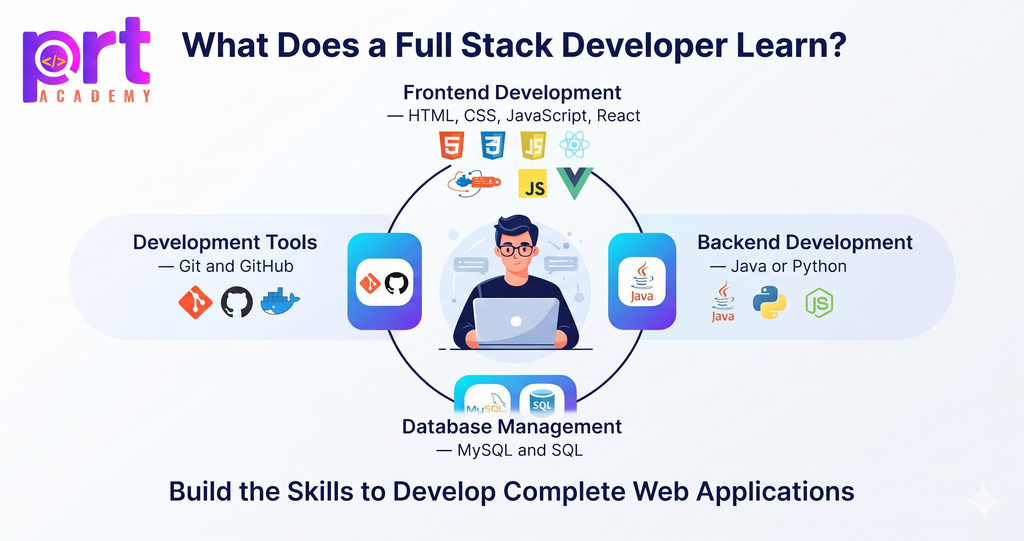
Full stack development involves building both the frontend and backend components of a web application.
The frontend is the part users interact with. The backend handles application logic, processes requests, and connects the application to databases and other services.
A full stack developer understands how these components work together to create a functional application.
Frontend Development
Front end development concerns designing the look of a website/ web application.
Common technologies include:
- HTML: Structures webpage content.
- CSS: Controls styling, layouts, spacing, and responsive design.
- JavaScript: Adds interactive functionality.
- React or Angular: Helps developers build dynamic user interfaces.
An example of front end development is the product page which displays products, pricing, search filters and navigation features.
A front end developer will need to ensure that their site is usable, responsive, accessible and performant to provide a great user experience.
Backend Development
Backend development handles the logic that powers an application.
This can be things like user authentication, defining business rules, handling payments, validating data and communicating with databases.
Popular backend technologies include:
- Java with Spring Boot
- Python with Django or Flask
- JavaScript with Node.js and Express
- REST APIs
If a user fills out a registration form then the backend will handle the data they have provided, validate the request and store the correct data.
Database Management
Databases are used to store information needed by applications.
Some common examples of databases are MySQL, PostGreSQL and MongoDB.
Students should know how to create records, query data, update data, link together data and ensure data integrity.
Application Integration
In full stack development we will also connect our Front-end, Back-end and Databases.
Developers will need to know how to make API requests, handle different data types, manage errors, test applications and version control.
This knowledge will help beginner developers to move from individual coding tasks to building full web applications.
Why Learn Full Stack Development?
Full stack development provides a broad introduction to modern web application development.
Build End-to-End Applications
You can learn to create a complete application rather than working on only one component.
Your application could include an interactive front-end, backend API and database to store student data.
Develop Versatile Technical Skills
Knowledge of front-end development, back-end programming, databases and APIs will make you more able to work with other people in your software development team.
These skills also provide a foundation for learning additional frameworks and tools.
Explore Different Software Development Roles
Depending on your knowledge and experience, full stack development training can help you prepare for roles such as:
- Junior Full Stack Developer
- Frontend Developer
- Backend Developer
- Java Developer
- Python Developer
- Web Application Developer
- Software Engineer
A course does not automatically qualify someone for these roles. Employers may also evaluate programming ability, project experience, problem-solving, communication, and interview performance.
Build a Portfolio of Projects
Projects provide a way to demonstrate how you apply programming concepts.
A portfolio containing well-documented applications can help you explain your technical decisions and practical experience when applying for suitable positions.
What Should a Full Stack Developer Course in Hyderabad Include?
Not every course provides the same learning experience. Before enrolling in a full stack developer course in Hyderabad, review its curriculum and practical components.
Programming Fundamentals
A good learning path should introduce variables, data types, conditions, loops, functions, object-oriented programming, and problem-solving.
These concepts are the foundation for understanding more advanced technologies in full stack developer course in Hyderabad
Frontend Technologies
Look for training in HTML, CSS, JavaScript, and a relevant frontend framework or library.
You’ll have the opportunity to develop responsive pages, interactive forms, reusable components and API driven interfaces.
Backend Development
The course will cover application logic, handling requests, form validation, building APIs and error handling.
Depending on the selected stack, this may involve Java with Spring Boot or Python with Django or Flask.
Database Skills
Fundamentals of SQL, data retrieval, relationships, and updating a database.
Getting an understanding of how you can store and retrieve information in your application.
Git and Version Control
Git is useful for keeping track of changes in your code and working on projects with others.
Learning about repositories, commits, branching and merging will help familiarize you with common workflows.
Practical Projects
Projects will help you apply your front-end, back-end and database knowledge.
Will you be creating projects? Will there be code reviews? Will you learn how to debug issues?
Testing and Debugging
Developers will want to spot bugs, test different inputs and ensure all the application features are working properly.
Hands-on practice with debugging and testing.
Interview and Career Preparation
Technical knowledge is just part of what is required to become a developer.
Look for ways to practise technical questions, explaining your projects, improving your communication skills and learning how the application process works.
Java Full Stack vs. Python Full Stack: Which Should You Choose?
Java and Python are two possible paths for learners interested in full stack development. The right choice depends on your interests, learning goals, and target job requirements.
Java Full Stack Development
Java Full Stack development commonly combines frontend technologies with Java-based backend development.
A typical learning path may include:
- HTML and CSS
- JavaScript
- Core Java
- Object-oriented programming
- SQL and database integration
- Spring Boot
- REST APIs
- A frontend framework
- Git and GitHub
Java is used in many enterprise applications and backend systems. Learners who want to explore Java-based software development may find this path suitable.
Python Full Stack Development
Python Full Stack development combines frontend technologies with a Python-based backend.
A learning path may include:
- HTML and CSS
- JavaScript
- Python fundamentals
- Object-oriented programming
- SQL and databases
- Django or Flask
- REST APIs
- A frontend framework
- Git and GitHub
Python is used in web development and other technical areas, including automation and data-related applications.
Its readable syntax can be approachable for beginners, but building reliable applications still requires practice and a clear understanding of programming concepts.
How to Make Your Decision
Compare the curriculum, support from instructors, hands-on projects and job descriptions.
Avoid choosing a course based on the popularity of the language. Focus on the quality of the learning and whether the technology is right to explore the roles that interest you.
Why Practical Projects Matter in Full Stack Training
Concepts are not the same as implementation.
Hands-on projects will help you see where your knowledge is lacking, develop debugging skills and understand how various elements of an application work together.
Here are examples of projects suitable for beginners.
Student Management System
An application which lets users add, edit, search and manage student records.
This will give you practice building forms, validation, API calls, queries and basic user access.
Task Management Application
An application which lets users create tasks, set priorities, update status and filter completed tasks.
This will introduce you to CRUD (Create, Read, Update, Delete).
E-Commerce Website
A product catalog with search, product information and shopping basket.
More advanced versions could have user accounts, order management and payment integration within a secure testing environment.
Appointment Booking Application
Create a system for viewing and booking available appointments and keeping track of bookings
This will help to give learners an understanding of forms, form validation, database structure and application flow.
Business Dashboard
Create a dashboard which displays data from a backend API.
Enhance by adding search functionality, filtering, summary data and charting to help you practice displaying data and integrating into applications.
Ask how projects are allocated, how much individual work they expect and if the code is reviewed by instructors when choosing a training institute.
How PRT Academy Supports Full Stack Development Learning
PRT Academy provide a training service under the PRT Software Solutions company. This includes training in IT and programming courses. whilst PRT Software Solutions also provides technology services including software development, website development, mobile application development and consulting services.
This links the training with technology.
On the PRT Academy website they have Java Full stack and Python Full stack courses available. The course details highlight that the training includes practical projects and support with getting into your career.
Structured Technology Learning
A structured learning path will take you through the basics of programming, front-end, back-end and databases.
Make sure you know what is covered in the most up-to-date curriculum. What frameworks, tools and topics are included?
Hands-On Project Experience
Hands-on projects will allow you to put your knowledge into practice.
As part of your training, try to fully understand every feature you’re implementing. Practice testing your code and being able to explain why you designed things in a certain way.
Mentorship and Learning Support
The guidance can be helpful if you are new to the topic and make mistakes or have trouble understanding complex topics.
Ask about how much time the instructor will have, whether there are sessions to help you gain confidence, one to one feedback and how your project will be assessed.
Interview and Career Preparation
On PRT Academy’s website they do mention:
Interview practice, communication tasks, mentoring and career support.
This can help students gain experience in explaining technical concepts and presenting their project. How much you gain from these tasks will depend on your progression throughout the course, how much effort you put into them and what the requirements of the roles available to you are.
Explore PRT Academy
If you are comparing a full stack developer course in Hyderabad, review the available course options, curriculum, duration, training format, project requirements, fees, and terms before enrolling.
Visit the official website:
PRT Academy: https://www.prtacademy.com/
For information about PRT Software Solutions and its technology services, visit:
PRT Software Solutions: https://prtsoftwaresolutions.com/
How to Choose the Right Software Training Institute in Hyderabad
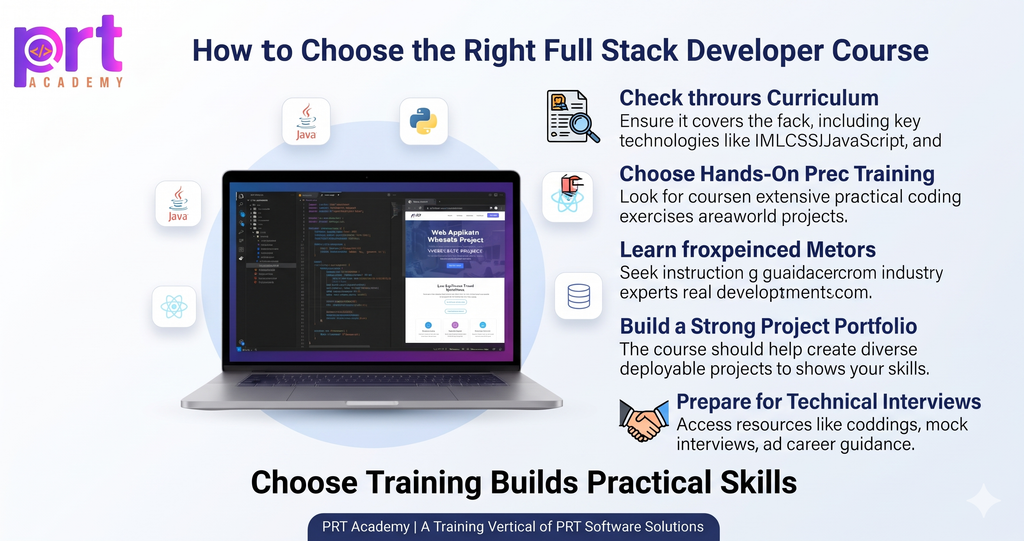
Before enrolling in a training program, compare several important factors.
Review the Complete Syllabus
Check whether the course includes programming fundamentals, frontend development, backend development, databases, APIs, version control, and project work.
Ask for a detailed curriculum rather than relying only on a course title.
Understand the Teaching Approach
Are there any demonstrations and guided practices? Are there coding tasks and self-practice?
The course should provide enough time to code and problem solve on your own.
Ask About Instructor Support
What is the process for answering questions? Are there code reviews? Can you get feedback if you make mistakes?
Evaluate the Projects
Can you see examples of the type of projects that learners do?
Do the projects include frontend/backend integration, databases, testing and documentation?
Compare Online and Classroom Learning
Choose a learning method that suits your lifestyle.
Ensure that you know what times classes will run, how many will be expected to attend, what resources will be available to you and what support you can expect.
Check Career Support Terms
Ask for the full details of any placement support or guarantee offered by the provider.
Know what the entry requirements are, what assignments you will have to complete, what interview prep you will need to do and any refund policies. Don’t assume that training will guarantee a job!
Compare the Overall Value
Course fees matter, but they should not be your only consideration.
Compare the curriculum, learning hours, project work, mentorship, resources, and support offered.
A carefully evaluated course can help you make a more informed decision about your training investment.
A Beginner-Friendly Six-Month Learning Roadmap
Your progress depends on your background, study time, and practice. The following is an illustrative learning plan rather than a guarantee of job readiness.
| Month | Learning focus | Suggested outcome |
| Month 1 | HTML, CSS, programming fundamentals | Build simple responsive webpages and small programs |
| Month 2 | Java or Python, problem-solving, OOP | Write programs using core language concepts |
| Month 3 | JavaScript and frontend framework | Build interactive user interfaces |
| Month 4 | Backend development and REST APIs | Create server-side application features |
| Month 5 | SQL, databases, Git, integration | Connect the frontend, backend, and database |
| Month 6 | Projects, testing, portfolio, interviews | Complete and document projects; practise interviews |
Some learners may need more than six months to develop confidence across all these areas. The goal is to demonstrate understanding and practical ability, not simply complete a schedule.
Common Mistakes to Avoid When Learning Full Stack Development
Learning Too Many Frameworks at Once
Focus on one primary technology stack before adding more frameworks.
Watching Tutorials Without Practising
Write your own code, change examples, and solve problems without following every instruction.
Ignoring Programming Fundamentals
A strong understanding of variables, functions, conditions, loops, and object-oriented programming makes advanced development easier to learn.
Copying Projects Without Understanding Them
Be prepared to explain your code, identify errors, and describe the choices you made.
Skipping Database Integration
A full stack developer should understand how application data is stored, retrieved, and updated.
Neglecting Communication Skills
Practise explaining your projects and technical decisions in clear language.
Expecting Immediate Employment
Course completion is only one milestone. Continue practising, building projects, improving your portfolio, and applying for roles that match your skills.
Career Opportunities After Full Stack Development Training
Full stack development training can provide a foundation for exploring several software development roles.
Possible entry-level pathways include:
- Junior web developer
- Frontend developer
- Backend developer
- Junior Java developer
- Junior Python developer
- Full stack developer trainee
- Software development intern
The responsibilities and requirements vary by employer. Some roles focus on a particular programming language, while others expect broader knowledge of web applications.
To strengthen your profile, maintain a portfolio of projects, practise coding problems, learn basic software development workflows, and prepare to discuss your work.
When applying for jobs, read the requirements carefully and tailor your resume to the skills you can demonstrate.
Frequently Asked Questions
Which is the best full stack developer course in Hyderabad?
The right course depends on your learning goals, preferred technology stack, budget, schedule, and support requirements. Compare the syllabus, practical projects, instructor guidance, and career preparation before deciding.
Does PRT Academy offer full stack development training?
PRT Academy’s published website lists Java Full Stack and Python Full Stack training. Check the official website for current batches, course details, and availability.
Is full stack development suitable for beginners?
Yes. Beginners can start with HTML, CSS, and programming fundamentals before progressing to frontend frameworks, backend development, and databases.
Should I learn Java Full Stack or Python Full Stack?
Both can provide a foundation for web application development. Choose based on your interests, the curriculum, and the requirements of the roles you want to pursue.
How long does it take to learn full stack development?
The duration varies according to your background and study schedule. A structured six-month learning plan can provide a framework, but additional practice may be needed to become confident and job-ready.
Are projects important in a full stack development course?
Yes. Projects allow you to apply programming concepts, integrate application components, practise debugging, and demonstrate your skills.
Does completing a full stack course guarantee a job?
No course should be assumed to guarantee employment without clearly defined written terms. Job outcomes depend on technical skills, project experience, interview performance, eligibility, and employer requirements.
What should I learn before joining a full stack course?
Many beginner programs start with the basics, so prior programming knowledge may not be necessary. Confirm the eligibility requirements of the specific course you plan to join.
Conclusion
Choosing a full stack developer course in Hyderabad can be a great way to get started with learning how to design web applications. The best courses will teach you fundamental programming concepts, front-end development, back-end development, databases, real world projects and help you improve your problem solving skills.
Before committing, look at a course’s curriculum, teaching methods, level of support from instructors, real world project work, type of training and career services. Set achievable goals and ensure that you will have time to practice coding on your own.
PRT Academy is the training arm of PRT Software Solutions. They offer training in Java Full Stack and Python Full Stack. Their website states that they offer real world projects, mentoring and career development.
Ready to explore your full stack development learning options?
Visit PRT Academy to review the available programs and contact the team for current course details, schedules, fees, and enrollment terms.
Explore PRT Software Solutions to learn more about the wider company’s software development and technology services.